No products in the cart.

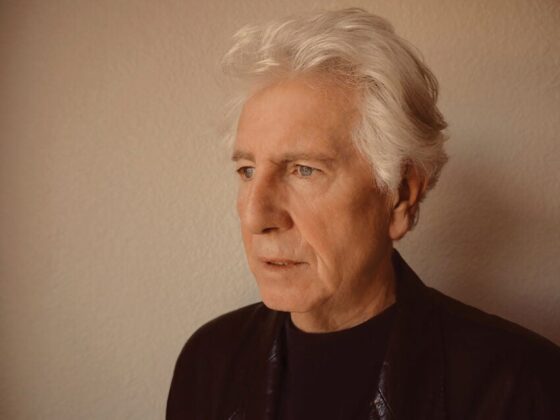

Graham Nash has big news upon his return to Mass. — a Crosby, Stills & Nash doc with 35 unheard tracks is on the way
Nash talks about his new book, new song, Muppets, Woodstock, fighting for the underdog, his love for David Crosby, and more.

Talk to Graham Nash over the course of a decade, and three strong themes emerge: undying love for his old friends, undying belief in the music he made with them, undying hope for this world.
He is all heart.
My Nash notes are peppered with quotable quotes:
On hearing CSN harmonize for the first time at Joni Mitchell’s bungalow: “I realized that I’d have to go back home and leave the Hollies and leave my money and leave my equipment and leave my friends and come and follow the sound we had just discovered. That’s how powerful that sound was.”
Advertisement:
On the 2016 election: “I made 16 paintings out of frustration.”
On adding Y to CSN: “Why would I want to [mess] with that sound? Who is this Neil Young? … Why did we want to add this guy?” So I went to breakfast with Neil on Bleecker Street, in New York, and after that, I would’ve made him president of the world … I said, “OK, he’s in.”
On life with one-time girlfriend Joni Mitchell: “We would light up a room when we entered. It was idyllic.”
And: “I’ve sent Joni flowers on her birthday every single year since we parted.”
Advertisement:
On making peace with the late David Crosby: “I thought it ended very well. We were emailing each other, voice-mailing each other for about two weeks before he passed. I set up a time to FaceTime with him, because I wanted to see his face. But he never made the FaceTime date. Two days later, he was dead.”
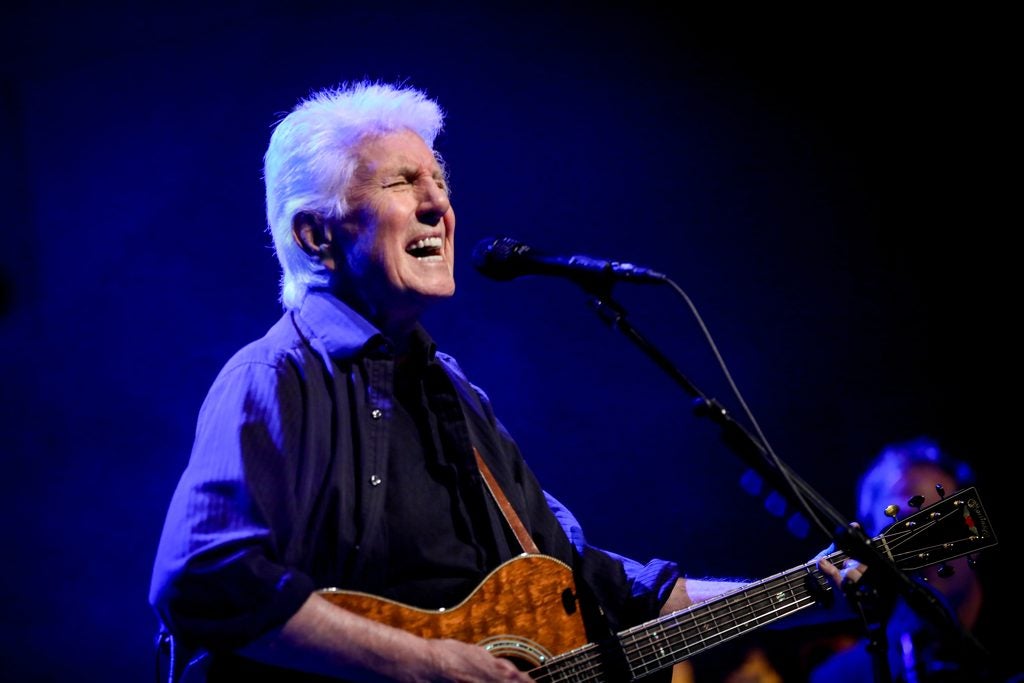
As an artist, the two-time Rock and Roll Hall of Fame inductee, OBE and Grammy winner is forever championing the underdog. The fire in his belly was lit when his father was wrongfully imprisoned in England, and was stoked at Woodstock and at mid-century American protests.
Both Crosby, Stills & Nash and Crosby, Stills, Nash & Young were integral fabrics in the tapestry of 1960s counterculture. CSNY was baptized by fire: their second show ever was at Woodstock.
Today on Instagram, Nash feels like our quiet, cool, wise hippie uncle. We follow Nash on his daily walks, might learn about an old CSN song, hear a Laurel Canyon memory or words of wisdom.
“My generation really believed peace was possible,” Nash posted recently. “It feels silly sometimes, to hope for peace when everything feels hopeless. Still, I hope because hope is an act of resilience these days. I’m going to keep pushing back every damn day. I hope you will too. – G”
Advertisement:
At 84, Nash isn’t slowing down: He’s working on a new album and a new book, and he says we can expect a CSN doc from Robert Zemeckis soon.
We caught up with the icon ahead of his string of six New England shows, including in Northampton Sept. 12 and Lowell Sept. 13.
Boston.com: I love your Instagram. I saw you were at Jim Henson’s Creature Shop recently. Is that for an upcoming project?
Graham Nash: No, that was a birthday present for my wife. She wanted to go there, and I thought, “What a wonderful present.” So I called and they were very [receptive]. You’d open a set of drawers and it would be all eyes. [laughs] You’d open another one, and it was all ears, or all mustaches. It was great.
[laughs] I love it. That’s an epic birthday. And on your most recent album, “Now” (2023), you have a beautiful love song for your wife, Amy. “Right Now” is about finding love later in life. You got married at 76.
[He sings: “I used to think that I would never love again/ I used to think that I’d be all on my own/ I really thought that it was coming to an end/ And just the thought of it chilled me to the bone.”]
When I was in my late 70s, I never thought I’d fall in love again. But I did. I’m with a woman now that I’ve been married for over six years. We’ve been together for over 11 years. I appreciate her wisdom and her artistry.
Are you writing new songs?
Always. My latest is called “ICE.” We’re probably going to record [an album] early next year, and I’ll probably record that. I might do it live — it’s a reasonably simple song to learn, so the people I’m playing with would pick it up immediately.
Advertisement:
I begin to realize that a lot of those songs that I wrote 50 years ago — “Immigration Man,” “Military Madness,” “Chicago/We Can Change the World,” “Teach Your Children”— are all incredibly relevant even today. We don’t seem to have learned much, have we?
True. That’s great that you have a new album coming out.
And Bob Zemeckis, the film director that did “Forrest Gump,” is working on a documentary of CSN.
My friend Joel Bernstein — a great photographer and an archivist; he was the guitar tech for Prince and Neil and Tom Petty — found 35 [tracks] you’ve never heard before. So we’re working on a record and hope to bring it out with the documentary. Probably spring of next year. Not so far away.
That sounds amazing. What would the documentary follow? Certain years?
Everything that we ever did. I don’t think they’ve come up with the title yet.
Wow. And the album is 35 unheard songs?
Yes. It is an amazing piece of work. I really began to realize how much we loved each other and how much we loved the music that Crosby, Stills, and Nash was making.
Those songs must hit you so differently now.
I know. But it makes me smile even now, and so that’s good.
You recently posted a beautiful song you wrote with David, “Taken at All.”
Ah, yes. That was a song about going on the road. When we made that first CSN record — because our bands, The Byrds, Buffalo Springfield, The Hollies, already had records — we realized a record of the three of us would be popular. But then the next realization, of course, is that you have to go on the road. And even though a lot of musicians love the couple of hours of music they’re making every night — the traveling sucks.
[laughs] I bet. You told me before that you and David made peace at the end.
You know, I think of David every single day. He’s in my prayers every night, of course. Life is full of choices, and I choose to only remember the really good stuff that happened between David and I. I miss the music we made together. That’s one of my main regrets about David’s passing, God damn him [laughs]. The lack of that music.
The anniversary of Woodstock just passed, too. That must have been a poignant moment.
Yeah. I remember singing “Guinevere” with one acoustic guitar and two voices — just me and David — and having to reach the very last row of the 400,000 people that were there. I think we did a pretty good job.
[laughs] I’d say so. What was it like flying in and playing there?
Like Crosby said, it was like flying over an encampment of the Macedonian Army from centuries ago. It was rainy and muddy and all that. We realized there was a collection of musicians that were going to play that were just phenomenal. Woodstock was an important part of my life.
I bet. Would you tour again with Stills and Young?
No. Once David passed, the heart of the band disappeared. I think if Stephen and Neil and I did want to play together, people would be wondering where David was. So I don’t think it will ever happen.
You did some shows with Emmylou Harris this summer. Last time we talked, you were touring with Judy Collins. It sounds like you’re still friends with a lot of the old gang.
Very much so. Judy’s been a friend since ’69. With Emmylou, we did three dates. Normally, she only goes out for three dates. She’s a homebody, and I love that. But yeah, we had good fun together. We sang one of Neil’s songs, “Birds.”
Are you still in touch with Joni?
Yes. First of all, I’m glad she’s alive [after her brain aneurysm in 2015]. Secondly, I’m glad that she’s working. We have to give a shoutout to Brandi Carlile for that. I saw that Newport [Folk Fest] show and realized that even though Joni’s range of voice is limited right now, her sense of timing was impeccable.
True. And you’ve also got your photography book, “A Life in Focus.”
I’m working on another one right now.
Nice. What inspires you these days for photos?
Well, I know what photos I don’t take. I don’t take kittens with balls of wool. I don’t take an image that matches my couch. I’d rather experience sunsets and sunrises. I don’t want to use my camera as a memory. I want my memory to be full-fledged.
Advertisement:
I like surreal objects that appear in front of me. I like moments that will disappear in a blink of an eye that people might want to enjoy. So in my new book, which I think is going to be called “Life and Light,” I want to share moments of my life with people.
You’ve been taking photos since you were a little kid.
I’ve been a photographer longer than I’ve been a musician.
Your father got you into it.
Very much so. He showed me the magic of photography, and I’ve never been the same. I recently found my first photos: one of a giraffe and one of an elephant at the local zoo near where I lived.
It was an amazing experience to see a blank piece of paper put into an almost colorless liquid, and then my father saying “Wait… wait…” And then here comes, fading into view, an image that I know my father took when he took me and my sister to the zoo. It was an amazing feeling. I’ve loved it ever since. In fact, in “A Life in Focus” is the first portrait of my mother I took when I was 11.
Wow. I love your self-portraits. I’ve always liked the one where you’re looking into a shaving mirror.
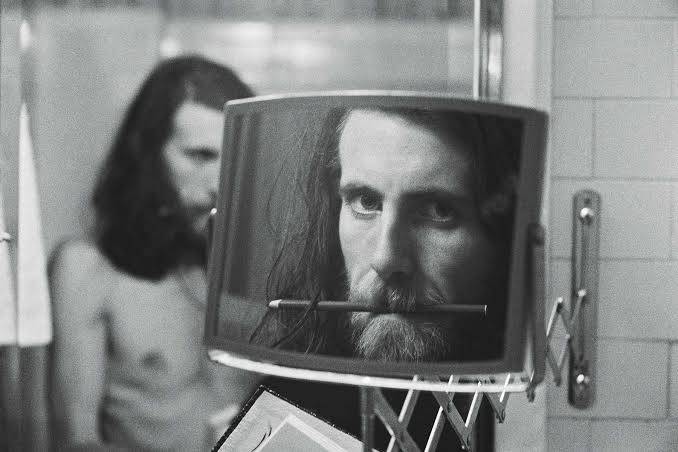
I love that one, too. You know I once had a show in Berlin of my self-portraits, and a woman came up to me and she said, “You know something?” I said, “What?” She said, “You need your head examined.”
[laughs]
I said, “Why?” She said, “Well, all these self-portraits are either reflections, they’re all broken, they’re all strange self-portraits.” I thought that was a funny thing to say.
We were talking about “Military Madness” and how your dad inspired topical songs. He did that in other ways, too. He was imprisoned over a camera, and that sparked your lifelong fight for the underdog.
Yes. He bought a camera from a friend of his at work. The police came to the door and wanted to know the name of the man that my father had bought the camera from because they thought it had been stolen. My father would not tell them who it was. They put him in jail for a year. He was never the same. I was 14 years old.
That must have been extremely traumatic.
Absolutely. Ever since I’ve been a champion of the underdog. The team that’s not supposed to win, or the tennis player that’s not supposed to win. I love it.
What’s your favorite CSNY song?
Two of them: “Suite: Judy Blue Eyes” and “Ohio.”
Interesting. That speaks to the themes we’ve been talking about: love for the old gang and the fighting for the underdog.
Very much so.
Advertisement:
Lauren Daley is a freelance culture writer. She can be reached at [email protected]. She tweets @laurendaley1, and Instagrams at @laurendaley1.
Sign up for the Today newsletter
Get everything you need to know to start your day, delivered right to your inbox every morning.



 Boston Live News